
1 / 1
Custom 3D Printing Applications in Hollow Bent Pipes Products, Pricelist
Product Description
Revolutionizing Marine Component Production Through Digital Foundry Technology
Our naval-grade bronze impellers represent a transformative approach to marine propulsion manufacturing, combining cutting-edge binder jetting 3D printing with precision CNC machining to deliver superior hydrodynamic performance and manufacturing efficiency.
Material Options
TUNGSTEN, Carbon Structural Steel, High-Quality Carbon Structural Steel, Alloy Structural Steel, Free-Cutting Steel, Spring Steel, Bearing Steel, Carbon Tool Steel
Surface Treatment & Machining
Surface Treatment: Brushing, Electropolishing, Vibratory Finishing
Machining Methods: Subtractive CNC Machining (Material Removal), CNC Milling, CNC Turning, CNC Drilling, CNC Grinding
Machining Methods: Subtractive CNC Machining (Material Removal), CNC Milling, CNC Turning, CNC Drilling, CNC Grinding
Innovative Hybrid Manufacturing Process
Binder Jetting 3D Printing
- Utilizes industrial-grade sand binder jetting systems with 0.1mm resolution
- Produces complex sand casting patterns in C95500 aluminum bronze or C86300 manganese bronze
- Incorporates integrated gating and riser systems during printing
- Achieves near-net-shape patterns with 0.1mm dimensional accuracy
Precision CNC Pattern Finishing
- 5-axis CNC machining centers with 0.005mm positioning accuracy
- Specialized tooling for pattern material machining
- Hydrodynamic profile optimization using CFD-validated toolpaths
- Achieves surface finishes of Ra 0.8μm on critical flow surfaces
Performance & Manufacturing Advantages
Hydrodynamic Benefits
- Optimized blade profiles improve efficiency by 8-12%
- Reduced cavitation potential through precision surface finishes
- Enhanced corrosion resistance through material homogeneity
- Improved fatigue life through controlled microstructure
Manufacturing Advantages
- 85% reduction in patternmaking lead time (3 weeks → 3 days)
- 40% reduction in overall production time
- Enables rapid design iterations for performance optimization
- Reduces material waste by 60% compared to traditional patternmaking
Quality Assurance & Marine Certification
Process Controls
- 100% dimensional inspection via laser scanning
- Surface profile verification against hydrodynamic specifications
- Pattern durability testing for high-volume production
- Shrinkage compensation algorithms for precise castings
Marine Standards
- Compliant with ABS Rules for Marine Propulsion Systems
- Meets ISO 484 Class I tolerances for commercial vessels
- Conforms to MIL-I-24107 for naval applications
- Material certifications to ASTM B584/B505
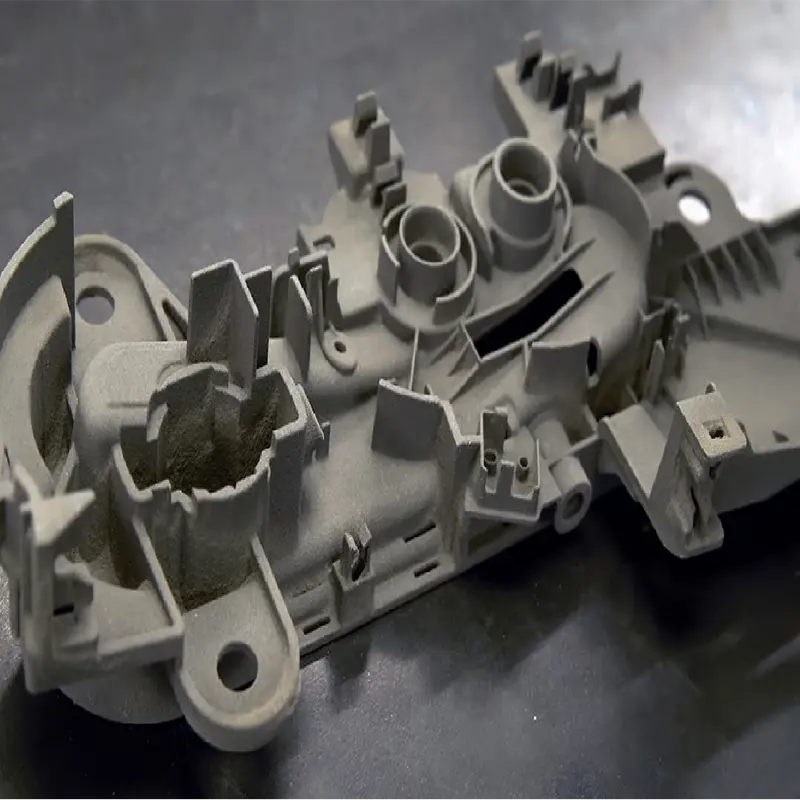
Consolidated Assemblies into Single Parts
3D printing integrates multi-component assemblies (e.g., fluid manifolds with internal channels), while CNC adds precision threads/ports. Example: Fuel injectors with 30+ parts reduced to 1, cutting assembly time by 90%.
Frequently Asked Questions
What materials are supported for casting and component manufacturing?
We support a wide range of materials including C95500 aluminum bronze, C86300 manganese bronze, TUNGSTEN, Carbon Structural Steel, High-Quality Carbon Structural Steel, Alloy Structural Steel, Free-Cutting Steel, Spring Steel, Bearing Steel, and Carbon Tool Steel.
How does hybrid 3D printing and CNC machining enhance accuracy?
Binder jetting 3D printing delivers near-net-shape sand casting patterns with 0.1mm dimensional accuracy, while 5-axis CNC machining centers provide 0.005mm positioning accuracy and surface finishes down to Ra 0.8μm on critical hydrodynamic surfaces.
What hydrodynamic performance gains can be expected?
By implementing CFD-validated toolpaths and precision surface finishing, optimized blade profiles achieve an 8-12% improvement in hydrodynamic efficiency, reduced cavitation risk, enhanced corrosion resistance, and prolonged fatigue life.
How significantly does digital foundry technology reduce lead times?
Patternmaking lead times are reduced by 85%—from 3 weeks down to just 3 days—while total production time is cut by 40% and raw material waste is reduced by 60% compared to traditional patternmaking.
Which naval and marine compliance standards are met?
Components conform to ABS Rules for Marine Propulsion Systems, ISO 484 Class I tolerances for commercial vessels, MIL-I-24107 for naval defense applications, and material standards ASTM B584 and ASTM B505.
How does part consolidation benefit complex components?
Additive manufacturing allows complex multi-part components—such as internal channel fluid manifolds—to be consolidated into single units, reducing assemblies of over 30 parts into 1 and cutting overall assembly time by up to 90%.









